Since 1933
OUR HISTORY
Ninety-three years, seven names and one standard. From a Kettering shoe factory to the Royal Albert Hall.
1933
“THE FINEST COMBINATION
IN THE COUNTRY”
On 2 January 1933, the Northamptonshire Evening Telegraph reported the formation of the Munn and Felton Works Brass Band. Fred Felton, co-managing director of the Kettering shoe firm, told the paper what he was setting out to do:
“We are out to make it the finest combination in the country, and to make it a contesting band of note throughout the country.”
Two years later they were champions of Great Britain. Within the band that ambition has always been remembered more simply — we are going to aim high — and it has been the standard ever since.
How it was built
Britain was deep in the Depression, and word of a new works band willing to pay its players brought them to Kettering one by one. Among the first was Bert Sullivan, a euphonium player just back from touring the United States and Canada with Besses o' th' Barn, out of work for three years with a wife to keep. He stayed 35 years as principal euphonium — the longest-serving player in the band's history.
Instruments were bought, a bandroom found, and uniforms ordered in black with lavish gold braid. One piece was missing: a conductor.
They got William Halliwell, who had taken bands to the National title nine times between 1910 and 1928. He was a considerable catch for an unknown works band from Northamptonshire, and they knew it.
The story
NINE DECADES
- 1933The band is formed
Announced in the Northamptonshire Evening Telegraph on 2 January. William Halliwell appointed conductor.
- 1934First national silverware
Munn and Felton win the second section of the National Championships.
- 1935Champions of Great Britain
At the Crystal Palace festival, against nineteen other championship bands, the band play K. A. Wright's Pride of Race and take the Thousand Guinea Trophy. They went straight from the hall to the BBC National Studio to broadcast to the country that evening. They also lift the Royal Trophy.
Two years and one day after the band was announced.
- 1939The band stops
Bandsmen are called away to serve. The band falls silent for close to seven years.
- 1946Stanley Boddington takes over
Players return to the factory and to the band. Boddington becomes resident conductor — a post he holds for nearly thirty years.
- 1946Midlands champions
The first of many regional titles, won on Labour of Love. Retained the following year.
- 1954British Open Champions
Boddington's band draw number one — and win from the opening slot, a feat almost unheard of at Belle Vue.
- 1955National Champions
A second National title, twenty years after the first. The Royal Trophy comes home again — and would not return for another seventy-one years.
- 1957National Champions
A third title, and the Midlands championship in the same year.
- 1960National Champions
A fourth national title.
- 1962GUS buy the factory
The GUS Group purchase the Munn and Felton works. The band becomes GUS (Footwear) — the name that has stuck for more than sixty years.
- 1964Variations on a Ninth
The band's performance of Gilbert Vinter's test piece wins the National Championships and is still spoken of as one of the finest readings in the contest's history.
- 1966National Champions
A sixth and, to date, most recent National title.
- 1966The GUS Quartet
John Berryman and David Read on cornet, John Cobley on horn and Trevor Groom on euphonium take the National Quartet title — and again in 1967 and 1968, playing pieces Vinter wrote for them.
- 1971World Champions
Under Stanley Boddington, on Robert Simpson's tone poem Energy.
- 1975Boddington retires
After 42 years with the band. Geoffrey Brand takes over, then Keith Wilkinson at the age of thirty.
- 1980Best of Brass
The Midlands title recaptured, and the band named winners of the BBC's Best of Brass. Voted BBC Band of the Year two years later.
- 1987Twenty-five years of GUS
GUS's sponsorship ends after a quarter of a century. Rigid Containers of Desborough step in, and give the band a decade of security and a new home.
- 1988British Open Champions
A second British Open title, on Wilfred Heaton's Contest Music, with Bramwell Tovey conducting.
- 1997Standing on its own
Rigid Containers' support ends. The band works hard simply to survive the economic pressure bearing down on banding.
- 2000Travelsphere Holidays
A new sponsorship takes effect on 1 April. Midlands titles follow in 2001 and 2004, along with placings at the Masters, the British Open and the Nationals.
- 2007Virtuosi GUS
Virtuosi England Ltd take on the band, providing a bandroom and the means to keep competing at the top. In the first month the band win the National Mineworkers contest; in June they take the March Championship at the French Open, playing The Australasian beneath the walls of Amboise Castle.
- 2013National Mineworkers Champions
Won again in 2017.
- 2015All England Masters Champions
One of the most demanding contests in the calendar — and the band win it back to back, in 2015 and 2016.
- 2014A run of Midlands titles
Regional champions in 2014, 2015, 2016, 2017 and 2018 — five in a row.
- 2020Midlands champions
And again in 2023, alongside the Dr Martin Wainstones Cup.
- 2026The Royal Trophy returns
At the 100th West of England Bandsmen's Festival at Bugle in Cornwall, the band take the championship section and lift the Royal Trophy — the first time since 1955, a wait of seventy-one years. The evening ends with the band playing Deep Harmony under the street lights, an hour before midnight.
- 2026The Royal Albert Hall
Midlands champions once more, and back to the National Final on 3 October.
The record
HONOURS
The full record
EVERY CONTEST
Every championship-section result the band has on record, back to 1935. Updated after each contest.
One band, seven names
WHAT WE'VE BEEN CALLED
Works bands carry the name of whoever keeps them going. Ours has changed six times; the players, the bandroom and the standard have not.
Twenty-five years of GUS sponsorship ended in 1987 and ten years of Rigid Containers in 1997. The band carried no sponsor's name again until Travelsphere in 2000, and has carried none since — which is why ‘Virtuosi’ was dropped in 2019.
On the box
MUSICAL DIRECTORS
Two men shaped the band's first half-century. William Halliwell brought the contest pedigree that made an unknown works band into champions inside two years. Stanley Boddington gave it forty-two years of his life, and took it to the World Championship.
Since then the box has rarely stood still. John Berryman had two spells and more contests than anyone since Boddington; Adam Cooke took five consecutive Midlands titles and back-to-back Masters. Christopher Bond, our Musical Director today, is a composer and conductor whose work has been performed across five continents.
Meet the bandDates mark time on the box — when each conductor was directing the band at contests — rather than formal appointments.
- 1933–1938
- William Halliwell National title-winning conductor nine times over, 1910–1928
- 1946–1975
- Stanley Boddington MBE Nearly thirty years resident; World Champions, 1971
- 1955–1960
- Harry Mortimer Guest conductor; National Champions 1955 and 1957
- 1976–1978
- Geoffrey Brand
- 1979–1986
- Keith Wilkinson
- 1985–1989
- Bramwell Tovey Guest conductor; British Open Champions, 1988
- 1986–1997
- John Berryman Midlands champions, 1996
- 1998–2000
- Melvin White
- 2001–2003
- Frank Renton, Brian Grant and Peter Parkes Midlands champions under Renton, 2001
- 2004–2007
- David Stowell Midlands champions, 2004
- 2008–2013
- John Berryman A second spell; Midlands champions 2010 and 2011
- 2013–2018
- Adam Cooke Five straight Midlands titles and the Masters in 2015 and 2016
- 2019–2022
- Chris Jeans Midlands champions, 2020
- 2023–2025
- David Thornton Midlands champions, 2023 and 2025
- From 2025
- Christopher Bond Musical Director. Midlands and West of England champions in his first full season
On record
FIFTY ALBUMS
AND COUNTING
The band has released more than fifty records since the 1930s — from Bandstand and Kings of Brass to The World Champions Play Test Pieces for Brass, and a Rhapsody in Blue with Don Lusher OBE.
A new album with World of Sound is in production now.
Listen to the band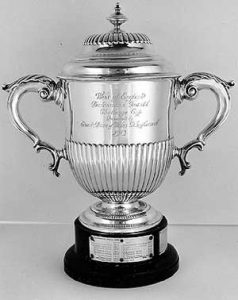
The Royal Trophy — won in 1935, 1954, 1955 and, after seventy-one years, again in 2026.
Ninety-three years on
STILL AIMING HIGH
The band rehearses twice a week in Northampton, competes at championship level, and plays for audiences across the country. Come and hear where the story is now.
See what's on